

Speak Friend and Enter
What Gandalf and engineering taught me about problem solving

Quick note: A few of you took me up on the Black Friday founding member rate (€4/month, going to €8 next week), and I briefly hit #38 in Substack’s Business category which is genuinely wild! Thank you! The founding rate is still active for another week. Click here to support my work and get a few extras:
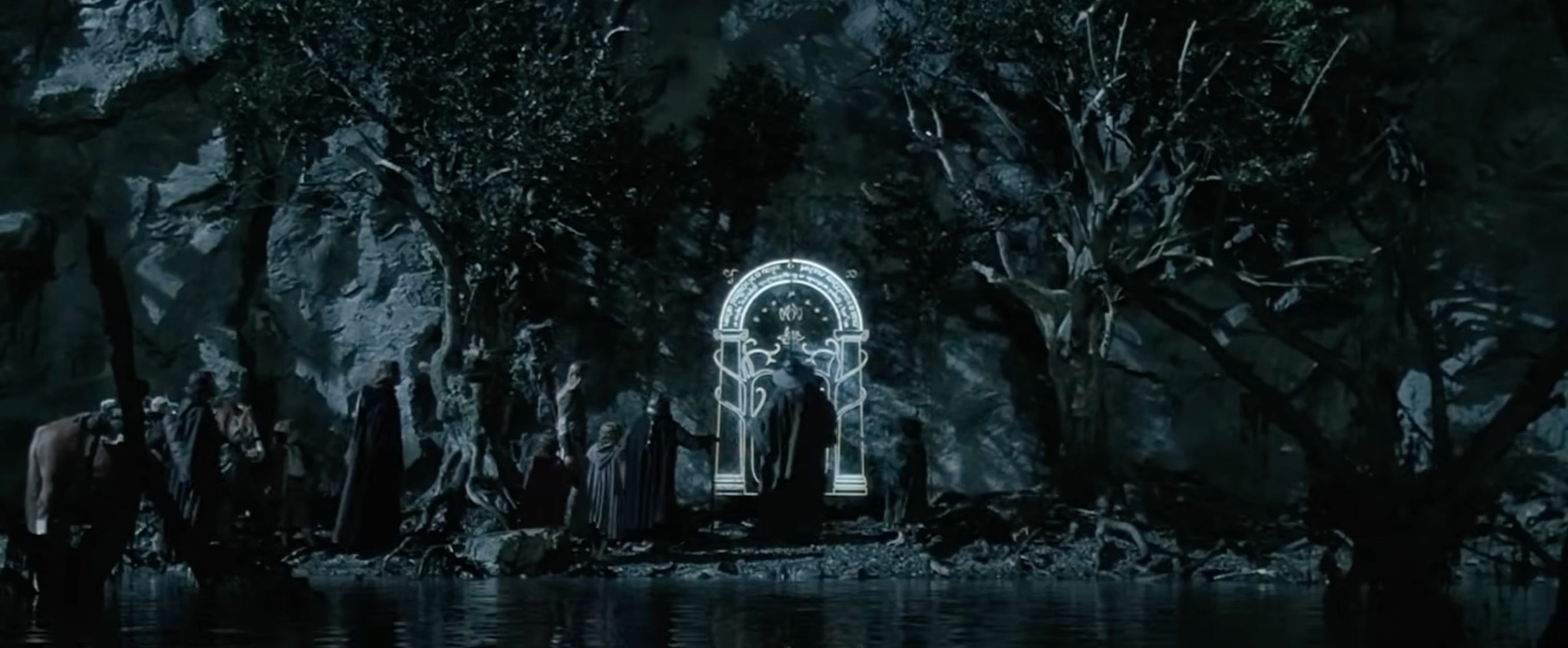
There’s a scene in the Fellowship of the Ring where Gandalf and the gang (which is coincidentally a great band name) stand in front of a huge wall with a glowing door on it. The Walls of Moria.
Gandalf utters the magic words. Nothing happens. He tries again. Still nothing. He threatens to bash Peregrin Took’s head against it. He can see the problem. He can even see the damn solution, it’s literally glowing. But the door will. not. open.
I’m sure we’ve all felt like Gandalf at some point (minus the ancient wizard part). That’s actually the way I’ve felt a lot in the past five years, asking myself big imposing questions for which I had absolutely no answer for and no idea how to “open the door”: What do I really want to do with my life? What’s really meaningful to me? Why can’t I just figure it out?
Sometimes I could see the door glowing in front of me. Sometimes it was just a wall.
Worse, I solve problems for a living. I’m an engineering manager by day. I’m (usually) good at taking vague problems and turning them into concrete next steps. So why was I spiralling?
Why abstraction keeps us stuck
Then I learnt about rumination, and that there’s actual psychology behind why these kinds of problems keep us stuck. Psychiatrist Dr. K has a great video on it. He explains that when we think about problems in abstract, generalised terms, it interferes with our ability to solve them. The more abstract we get (”what’s meaning anyway,” “why does nothing ever work out”), the more our brains struggle to identify concrete actions we can actually take.
When your brain is in “what’s the point of anything?” mode, it literally can’t generate a next step.
The abstraction is too great. It makes us pessimistic, strips away the specific details we need to move forward, and leaves us with conclusions that feel profound but are completely inactionable. We might even think we’re problem-solving, but we’re actually just magnifying the problem and making it harder to find a way forward.
Like Gandalf, you might just be overthinking it.
Enter the Five Whys
This is where my LOTR metaphor falls apart, but stick with me.
Gandalf didn’t have the luxury of learning about ✨ corporate engineering processes ✨, but I decided to start using my own knowledge of them to my advantage. In engineering, we have a tool called the Five Whys.
Like a lot of modern tech processes, it was developed by Toyota in the 1970s (because of course it was). The idea is simple: keep asking “why” so that you can drill down from vague symptoms and big problems (“why wouldn’t the door open when we needed it to”) to specific root causes (“because Gandalf didn’t realise the riddle was literal”).
Often, doing this five times is all it takes. We use it at work all the time but I never thought to use it on my own problems.
So I decided to try it.
The Five Whys in practice
Taking a recent example from my own life, for the past year I’ve been spiralling on a problem: What should I actually do with my photography? I want to share it, but why, and where? Why do I even want to do that?
I’d find myself scrolling Instagram at 10pm on a Tuesday night, admiring all the work of other photographers, knowing all the photos from my last trip were sitting there untouched, feeling a deep urge to share my work, but simultaneously hating Instagram and the Zuck-ness of it.
I was stuck in front of the shiny door without a way through.
Starting with the problem statement, I asked myself why:
“I’m frustrated that I don’t know what to do with my photography.”
Why am I frustrated? Because posting on Instagram isn’t satisfying, but I still want to share somewhere.
Why do I want to share it if Instagram doesn’t work? Because there’s genuine joy for me in sharing my work and connecting with other photographers. Sharing motivates me to edit, collate, and “finish” my work.
Why don’t I like Instagram? Too many ads, no meaningful interaction, no space for context, and I don’t want to fuel Zuck’s empire.
Why not try other platforms? Because I don’t want to use even more social media. Actually I want to use less.
Why not just use the social media platforms I’m already using? Because I… haven’t?
And just like that, I opened the door.

Without really trying I came up with two ways forward. I already use Substack for this newsletter, so I could start there by: (1) Sharing photography in my newsletter posts, and (2) Sharing photos in Substack Notes.
I like the platform, it removes the Instagram sticking point, and gives me a way to try sharing again. And that’s what I’ve been doing! I don’t know if either will work long-term, but door one feels good so far. At least they haven’t lead me into Khazad-dûm.
Speak friend and enter
Jokes aside, the key thing I’ve been learning is that you have to try a few doors. And the nice thing is that in real life, there are almost always more doors to try out.
The best part is that they actually lead somewhere.
You walk through, see what’s on the other side, and recalibrate. It might not be the perfect door (and hopefully there are no orcs on the other side), but at least you learned something by trying instead of thinking. So you try another door. And repeat.
I’m sure this won’t work on everything, but if you’re stuck on something that feels unsolvable, and if you’re staring at a door you can’t open, give it a try.
You might be surprised how many doors just needed the right word to open.
I was.
Good stuff this week
Internet companies don’t owe anyone free traffic - Adam Singer’s hot take on why platforms don’t love you back, and why no one “owes” you traffic for existing. I’m very thankful I chose email as my place to write, but every day I grow more skeptical of the platform I’ve chosen to do it (Substack).
The Big Book Launch Post - An incredible resource from Jonathan Goodman on planning a book launch. I know I’m going to be coming back to this a lot in the next few months.
An audience doesn’t solve your problems - Russell Nohelty breaks down the data on how many sign-ups he gets from a list of ~46k people.
Can ChatGPT Land an Airplane? - A great watch if you want to be simultaneously infuriated and entertained by the limits of AI.
And completely different to everything, watch an octopus learn how to play the piano.
You made it all the way down here! If you want to support the newsletter & podcast and get a few extras, you can do that here:
Very good stuff. And thanks for sharing my book launch article!